

VMware Replacement
Major Changes After Broadcom Acquired VMware
VMware was acquired by Broadcom on November 22, 2023. Here are the challenges the acquisition brought to customers.
-
Long-Term Subscription Price Hikes: 3-year subscriptions are now 1.5 times more expensive, and 5-year subscriptions are twice as expensive.
Forced Over-Licensing: Minimum core purchase jumps from 16 to 72 cores per CPU (effective April 2025), requiring customers to pay for unused cores.
vSAN Expansion Costs: Exceeding scalable storage beyond free vSAN entitlements mandates relicensing of the whole raw capacity
-
Zero Grace Period: Immediate late fees apply upon subscription expiry.
Retroactive Penalties: 20% fee on first-year subscription costs for renewals after the anniversary date, even for accidental delays.
-
Reintroduced Licensing Tiers: vSphere Standard and Enterprise+ return, but the retirement of Essentials+ limits options for smaller deployments.
Add-on Features: Many advanced features (e.g., vSAN, NSX, vRealize) require separate licenses, making budgeting and planning more difficult.
-
Broadcom is eliminating VMware’s “Registered” partner tier and white-label program, disqualifying over 18,000 small resellers and reducing opportunities for SMB-focused providers.
The new partner structure is more exclusive, with an invitation-only VCSP program and elevated technical and operational requirements that favor large, well-resourced partners.
Broadcom is realigning VMware’s focus toward large enterprises and hyperscale private cloud platforms, deprioritizing the needs of smaller customers and partners.
The Challenges of Replacing VMware
Based on research involving over 200 industry clients,
here are the key issues VMware users should consider when opting to replace VMware.
Product Reliability
The replacement of the underlying platform has a broad impact. It's crucial to avoid scenarios where the new product cannot address issues or sustain evolution.
Functionality and Performance
Does the new platform meet business requirements in terms of functionality and performance? Are there any missing features or performance issues that could degrade platform service capabilities?
Operational and Maintenance Reliability
Can the new platform ensure stable business operations? Are the mechanisms for handling various abnormalities robust, and is the operational and maintenance management straightforward?
Seamless Integration with Existing Ecosystem
Can the new platform be compatible and integrate with existing software and hardware resources? Is it possible to achieve a smooth replacement with little to no modification?
Smooth Migration from VMware
When migrating business operations from the VMware platform, what is the impact on the business? Is the migration process convenient and minimally disruptive?
Innovative Advantages and Capabilities
Does the new platform offer innovative capabilities and advanced features? Can it support business and operational management needs, as well as future upgrades and evolution?
Introducing Sangfor Hyperconverged Infrastructure
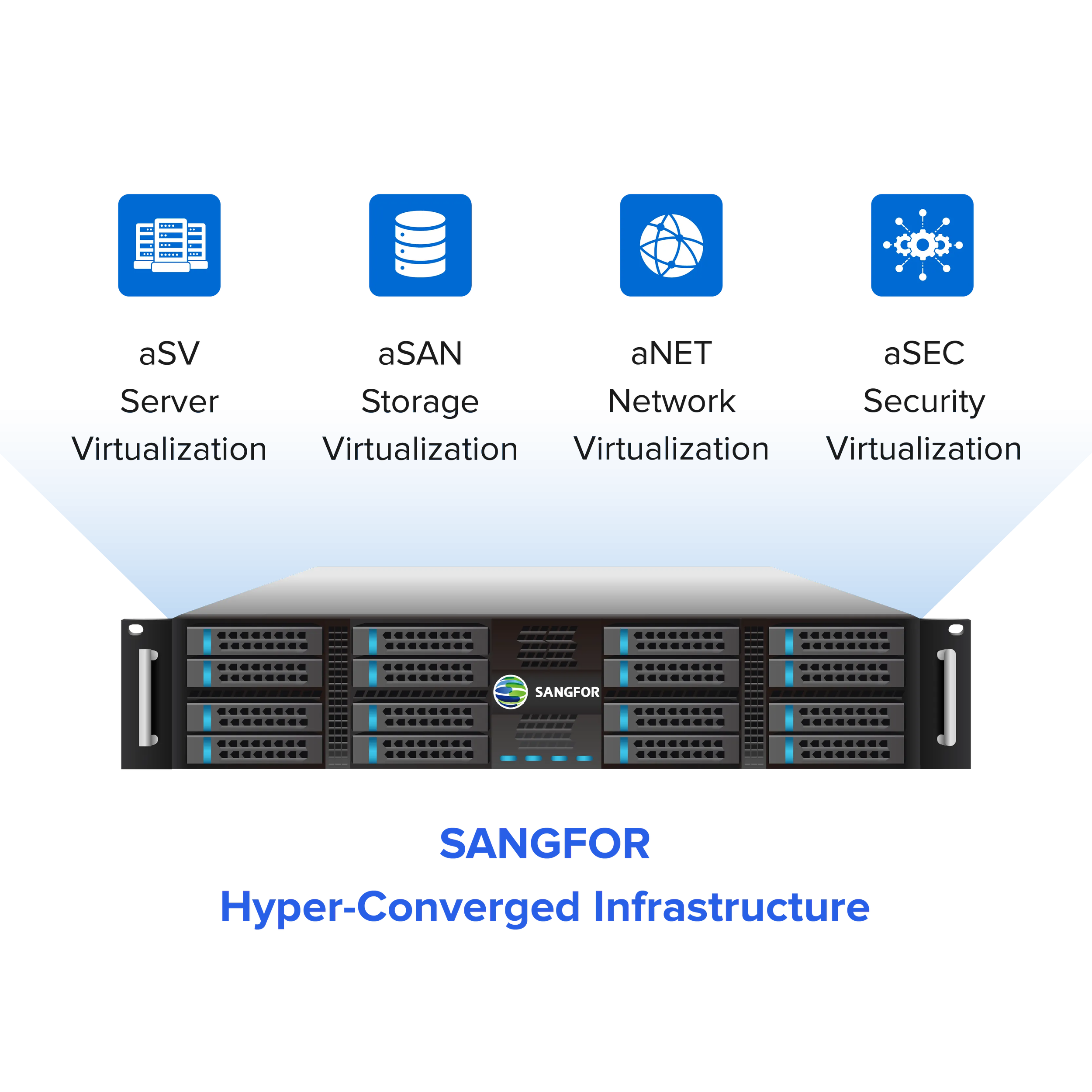
Sangfor Hyper-Converged Infrastructure (HCI) provides innovative 3rd-gen cloud computing architecture that reduces at least 70% of the TCO, simplifies operations, and multiplies network security. It converges compute, storage, networking and security on a single software stack.
1-stop software-defined data centre solution
Easy operation and quick installation for business-critical applications
Integrates with any commodity servers commercially available in the market
Build your own private cloud, extend to a public cloud or create your own Hybrid Cloud
How is Sangfor The Ideal Replacement For VMware?

Flexible choice between perpetual or subscription license.

Equivalent and cost-effective alternatives to VMware offerings.

Robust local office presence with no support concerns.
Evolve from server virtualization-only to hyperconverged systems.
Sangfor vs VMWare: Product Architecture Comparison
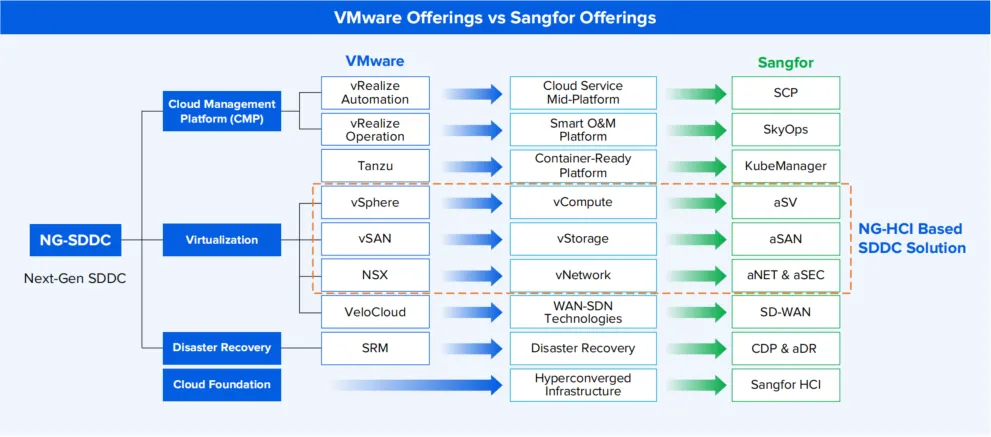
Sangfor vs VMWare: Product Feature Comparison
| Feature | Sangfor HCI | VMware vSphere / VSAN / NSX |
|---|---|---|
| Hypervisor | aSV – Enterprise features near vSphere Enterprise Plus | vSphere Standard (limited) or Enterprise Plus (costly) |
| Networking | aNet – Built-in, visualized, easy-to-use | NSX – Advanced but requires extra licensing & expertise |
| Storage | aSAN – Fully integrated, distributed SDS | vSAN – Add-on, extra licensing required |
| Security | Built-in NGFW, WAF, IPS, Vulnerability Scan, Gateway, NDR, Load Balancer | Third-party appliances required |
| Licensing | Flexible – Perpetual or subscription* | Subscription-only, higher overall cost |
| Cloud | Hybrid-ready, Sangfor Cloud integration | Broad multi-cloud ecosystem, higher TCO |
Features and Benefits of Sangfor HCI
More cost-effective solutions

Continue to enjoy a perpetual license with Sangfor HCI
Free Cloud Lightweight Consultancy (For easy migration and going to the cloud)
Easily migrate from VMware to Sangfor

Local vendor office and local support

24/7 Online Support
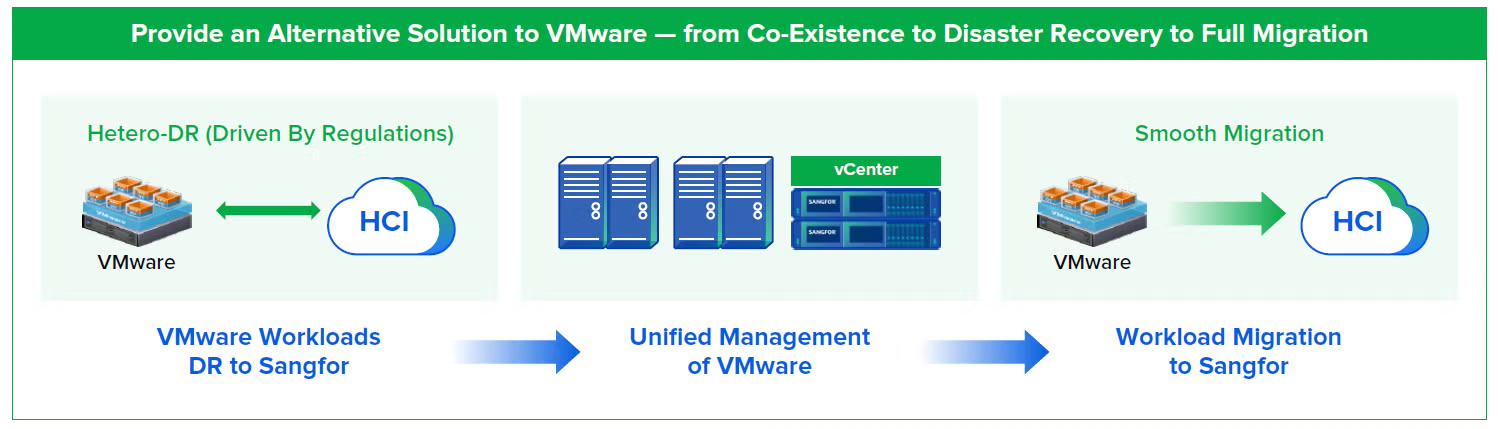
Structured VMware Migration with Sangfor: Minimize Risk, Maximize Trust

Step 1: Hybrid Coexistence
Maintain parallel operations to ensure continuity and minimize disruption.

Step 2: Phased Migration & Disaster Recovery
Execute incremental migration with built-in disaster recovery safeguards.

Step 3: Full Transition to Sangfor
Decommission VMware and complete the seamless switch to Sangfor’s platform.
Seamless VMware to Sangfor HCI Migration Demo Guide
Sangfor Hyper-Converged Infrastructure (HCI) emerges as a robust and cost-efficient alternative, recognized in the Gartner Market Guide for Full-Stack HCI. In this detailed video, we demonstrate two straightforward methods to seamlessly migrate your workloads from VMware to Sangfor HCI, ensuring a smooth transition and enhanced infrastructure management.